
Stress and Dysregulation
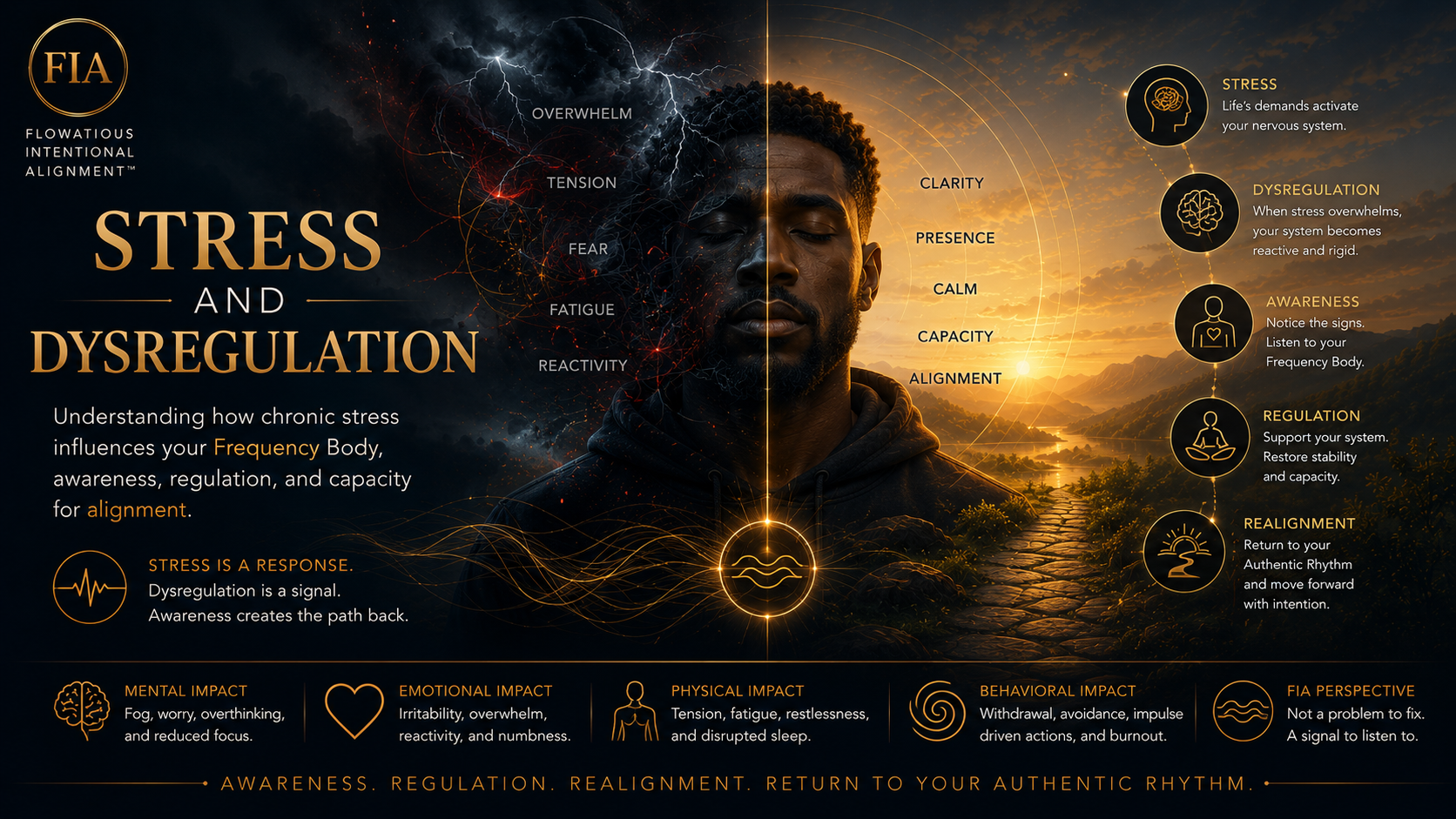
Understanding how chronic stress influences your Frequency Body, awareness, regulation, and capacity for alignment.
Why This Page Exists
Stress is a natural part of life. Challenges arise. Responsibilities increase. Unexpected situations occur. The human system is designed to respond to stress. However, when stress becomes chronic or overwhelming, it can begin influencing how we think, feel, behave, and experience the world.
Within FIA, this state is often described as dysregulation. Understanding dysregulation helps us respond with awareness rather than judgment.
What Is Stress?
Stress is the body's response to perceived demands, challenges, pressures, or threats.
Stress itself is not inherently negative.
In many situations, stress can help us focus, adapt, respond, perform, and survive.
The challenge arises when stress becomes persistent without sufficient recovery and regulation.
What Is Dysregulation?
FIA Definition
Dysregulation is a state in which the Frequency Body becomes overwhelmed, disrupted, or less able to maintain flexibility, stability, and responsiveness.
When dysregulation occurs, access to clarity, presence, and intentional action may become limited.
The FIA Perspective
Within FIA, dysregulation is not viewed as weakness. It is not viewed as failure. It is information. It is feedback. It is communication. Often, dysregulation signals that the system is carrying more than it currently has the capacity to process effectively.
How Stress Influences the Frequency Body
The Frequency Body reflects the interaction between thoughts, emotions, sensations, physiology, and environment.
When stress accumulates, these layers often become more reactive and less flexible.
A person may begin experiencing:
Heightened tension
Mental fog
Emotional overwhelm
Irritability
Exhaustion
Disconnection
Difficulty concentrating
The Frequency Body is communicating that support may be needed.
Common Signs of Dysregulation
Dysregulation can appear differently from person to person.
Common experiences include:
Mental Signs
Racing thoughts
Difficulty focusing
Constant worry
Overthinking
Brain fog
Emotional Signs
Irritability
Emotional reactivity
Feeling overwhelmed
Increased sensitivity
Emotional exhaustion
Physical Signs
Muscle tension
Fatigue
Restlessness
Sleep disruption
Feeling constantly "on edge"
Behavioral Signs
Withdrawal
Procrastination
Doom scrolling
Overworking
Impulsive decision-making
Dysregulation and Borrowed Rhythms
One of the most important FIA teachings is that stress often increases vulnerability to Borrowed Rhythms.
When overwhelmed, people may begin:
Following expectations instead of intuition
Prioritizing performance over authenticity
Ignoring internal signals
Living reactively rather than intentionally
The farther we move from our Authentic Rhythm, the harder alignment may become.
Protection vs Presence
Within FIA, chronic stress often shifts people toward protection. Protection is not inherently bad. It is a natural response.
However, when protection becomes the dominant state, people may experience:
Hypervigilance
Emotional guarding
Constant urgency
Difficulty resting
Difficulty trusting themselves
Presence becomes harder to access.
Why Awareness Matters
One of the most powerful shifts occurs when a person stops asking:
"What's wrong with me?"
and begins asking:
"What is my system trying to communicate?"
This simple shift creates space for curiosity, empathy, and regulation.
The Path Back
Within FIA, the response to dysregulation is not self-criticism. The response is support.
The path back often includes:
Awareness
Recognize what is happening.
Regulation
Support the Frequency Body.
Reflection
Listen to what the experience is communicating.
Return
Reconnect with Authentic Rhythm.
Realignment
Take intentional action.
The Relationship Between Stress and Alignment
One of the central teachings within FIA is:
Alignment becomes harder to access when dysregulation increases.
This does not mean alignment disappears. It means access may become obscured. As regulation improves, awareness often becomes clearer. As awareness becomes clearer, alignment becomes more accessible.
The FIA Ecosystem Connection
Stress
      ↓
Dysregulation
      ↓
Frequency Body Activation
      ↓
Visceral Awareness
      ↓
Regulation
      ↓
Realignment
      ↓
Alignment
The goal is not to eliminate every experience of stress. The goal is to build the capacity to navigate stress more intentionally.
Reflection:
How does stress typically show up in my life?
What signals tell me that my system is becoming overwhelmed?
What helps me feel more regulated and present?
Stress is part of life.
Dysregulation is information.
Neither defines who you are.
Within FIA, these experiences are viewed as invitations to pause, listen, support the system, and return to your Authentic Rhythm.
The path forward is not perfection. The path forward is awareness, regulation, and intentional realignment.