
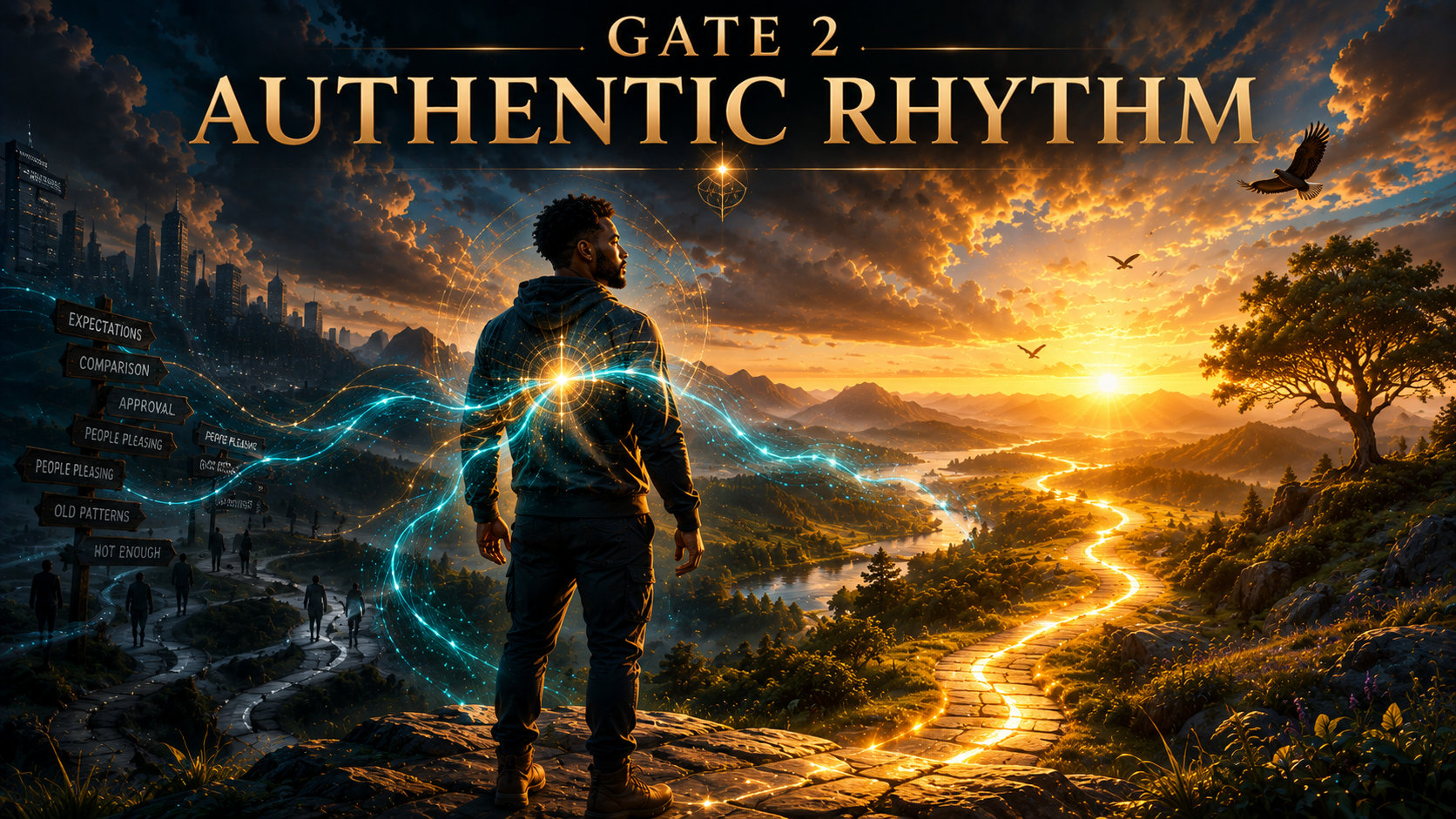
Gate 2: Authentic Rhythm
The discovery of your natural way of thinking, feeling, moving, expressing, and living.
The Second Gate of Flowatious Intentional Alignment
Returning Is Only the Beginning
The Return creates awareness. It creates honesty. It creates space. But eventually another question emerges:
If I am no longer living entirely from borrowed rhythms, then what rhythm is truly mine?
This question marks the entrance to Gate 2. The purpose of Gate 2 is not to create an identity. It is to uncover the rhythm that already exists beneath conditioning, performance, fear, and expectation.
What Is Authentic Rhythm?
FIA Definition
Authentic Rhythm is the natural pattern of thoughts, emotions, actions, values, energy, and expression that emerges when a person is living in alignment with their true nature rather than a borrowed rhythm. Every individual possesses a unique Authentic Rhythm. The purpose of FIA is not to manufacture it. The purpose is to remember it, trust it, and live from it.
Why Authentic Rhythm Matters
Many people spend years trying to become someone else. They chase external validation. Social expectations. Cultural standards. Performance-based identities. And borrowed definitions of success. Yet even when these pursuits create achievement, they do not always create alignment.
Authentic Rhythm offers a different path.
Instead of asking: “Who should I become?”
Gate 2 asks: “Who am I when I stop pretending?”
The Signs of Authentic Rhythm
Authentic Rhythm often reveals itself through recurring experiences.
Ease
Not the absence of effort, but the absence of unnecessary force.
Congruence
Your actions reflect your values.
Clarity
Decisions become easier to navigate.
Vitality
Energy feels more available and sustainable.
Authentic Expression
You feel less pressure to perform and more freedom to be yourself.
Presence
Life feels less like acting and more like living.
Authentic Rhythm Is Not Perfection
One of the greatest misconceptions about alignment is the belief that Authentic Rhythm means life becomes effortless. Within FIA, this is not the case.
Authentic Rhythm does not eliminate: Challenge, fear, growth, discomfort, or uncertainty.
Instead, it changes your relationship with those experiences. You move through them as yourself rather than as a performance of who you think you should be.
Borrowed Rhythms vs Authentic Rhythm
One of the central lessons of Gate 2 is learning the difference between what is yours and what has been inherited.
Borrowed Rhythms often sound like:
"I should."
"I have to."
"People expect me to."
"This is what success looks like."
"This is who I'm supposed to be."
Authentic Rhythm often sounds like:
"This feels true."
"This reflects who I am."
"This aligns with my values."
"This feels congruent."
"This feels like me."
Learning to recognize this distinction is one of the major tasks of Gate 2.
Authentic Rhythm and the Frequency Body
The Frequency Body often provides valuable feedback regarding Authentic Rhythm. When moving toward alignment, individuals may notice: Increased regulation. Greater ease. Reduced internal conflict. More clarity. And greater emotional flexibility. When moving away from alignment, the Frequency Body may communicate through: Chronis tension. Persistent frustration. Exhaustion. Resistance. And disconnection. These signals are not always commands. They are invitations to pay attention.
Authentic Rhythm and Visceral Awareness
Authentic Rhythm is rarely discovered through intellect alone. It is often recognized through awareness. This is why Visceral Awareness becomes increasingly important within Gate 2.
The more clearly you can notice what is happening within your Frequency Body, the easier it becomes to distinguish between:
Alignment and performance
Truth and conditioning
Authentic Rhythm and Borrowed Rhythms
The Courage of Authenticity
Authentic Rhythm often requires courage. Because once you recognize your rhythm, you may begin noticing where your life no longer reflects it.
You may outgrow:
Certain beliefs
Certain habits
Certain environments
Certain expectations
Certain identities
This is not failure. This is growth.
What Gate 2 Teaches
Gate 2 teaches: Self-recognition. Authenticity. Discernment. Congruence. Trust in oneself. Awareness of Borrowed Rhythms. Most importantly, it teaches that alignment begins with honoring what is genuinely yours.
Reflection Questions:
What feels most authentic to me right now?
What parts of my life feel naturally aligned?
What parts of my life feel borrowed?
If no one else's expectations existed, what rhythm would naturally emerge?
The Gate 2 Commitment
Before moving forward, the seeker makes a simple commitment:
I am willing to recognize my Authentic Rhythm.
I am willing to question borrowed rhythms.
I am willing to live more honestly from what is true within me.
Gate 1 teaches you to return.
Gate 2 teaches you what you are returning to.
The more clearly you recognize your Authentic Rhythm, the more clearly you can align your life with the person you have always been beneath the noise.
That recognition is Gate 2.
➡️ Gate 3: The Frequency Body
⬅️ Gate 1: The Return