
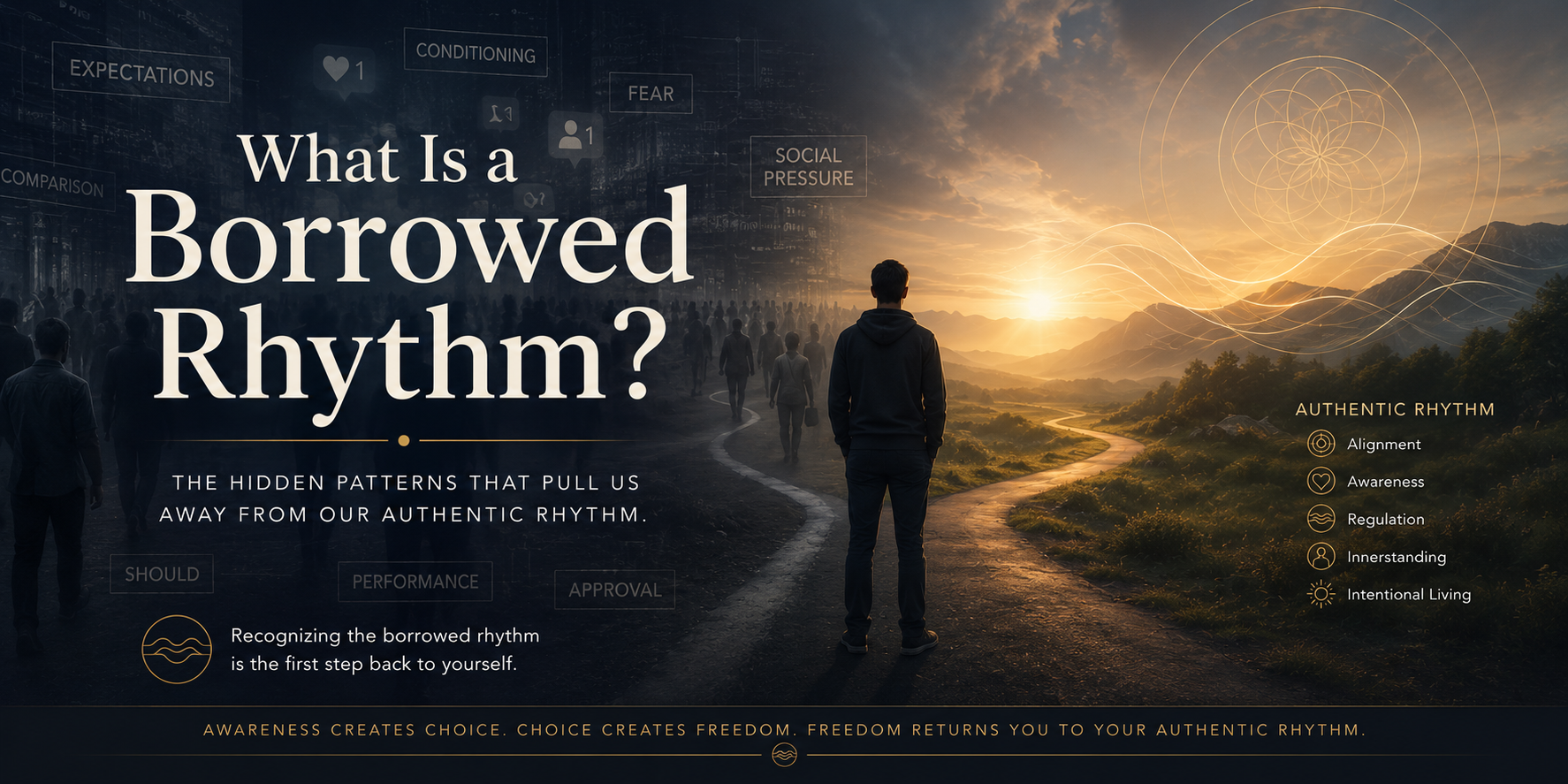
What Is a Borrowed Rhythm?
The hidden patterns that pull us away from our Authentic Rhythm.
The Rhythm Beneath the Life
Within Flowatious Intentional Alignment, every person is believed to possess an Authentic Rhythm—a natural pattern of thinking, feeling, acting, and expressing that reflects who they genuinely are. Yet many people spend years living according to rhythms they never consciously chose.
They adopt expectations. They absorb beliefs. They inherit behaviors. They follow cultural scripts. Over time, these external influences can become so familiar that they feel natural, even when they are not. This is what FIA refers to as a Borrowed Rhythm.
The FIA Definition
Borrowed Rhythm
A Borrowed Rhythm is a pattern of thinking, feeling, behaving, pursuing, or expressing that originates primarily from external conditioning rather than authentic self-awareness.
Borrowed Rhythms often develop through:
Family conditioning
Social expectations
Cultural norms
Trauma responses
Fear of rejection
Survival strategies
Performance-based identity
Comparison and conformity
While some borrowed rhythms may appear beneficial on the surface, they often create tension when they conflict with an individual's Authentic Rhythm.
How Borrowed Rhythms Develop
Most Borrowed Rhythms are not intentionally chosen. They are gradually absorbed. As children, we learn how to behave by observing the people around us. As adults, we often continue adopting patterns from environments, communities, workplaces, social media, and relationships. Eventually, a person may begin living according to what they believe they should be rather than who they actually are.
Signs You May Be Living from a Borrowed Rhythm
Borrowed Rhythms often reveal themselves through recurring experiences such as:
Chronic Exhaustion
Living in a way that constantly feels forced.
Persistent Inner Conflict
Feeling divided between what you want and what you believe you should do.
Difficulty Trusting Yourself
Seeking constant external validation before making decisions.
Performance-Based Identity
Feeling valuable only when producing, achieving, or pleasing others.
Disconnection from the Body
Ignoring inner signals in favor of expectations and obligations.
Emotional Incongruence
Saying yes when you mean no. Smiling when you feel resentment. Performing confidence while feeling disconnected.
Borrowed Rhythms and the Frequency Body
Within FIA, Borrowed Rhythms often create tension within the Frequency Body.
When a person's actions consistently conflict with their Authentic Rhythm, the body may begin communicating through:
Stress
Fatigue
Irritability
Anxiety
Emotional overwhelm
Chronic tension
Dysregulation
These experiences are not always signs that something is wrong with the person. Sometimes they are signals that something is out of alignment.
The Shadow Side of Borrowed Rhythms
One of the most challenging aspects of a Borrowed Rhythm is that it can become successful.
A person may receive:
Praise
Recognition
Status
Financial rewards
Social approval
Yet still feel disconnected from themselves. External success does not automatically equal alignment. A Borrowed Rhythm can be applauded by the world while quietly creating conflict within.
Returning to Authentic Rhythm
The purpose of FIA is not to judge Borrowed Rhythms. Many Borrowed Rhythms began as attempts to stay safe, belong, survive, or succeed. The goal is not self-criticism. The goal is awareness. Once a Borrowed Rhythm is recognized, a person can begin the process of realignment. This is where Visceral Awareness, the Frequency Body, and the FIA Regulation System become essential tools.
Why This Doctrine Matters
Borrowed Rhythms are one of the primary sources of misalignment.
They can influence:
Relationships
Career choices
Daily habits
Self-image
Emotional patterns
Stress responses
Personal identity
Without recognizing them, a person may spend years trying to improve a life that was never built from their Authentic Rhythm in the first place.
Reflection
Ask yourself:
What areas of my life feel chosen, and what areas feel inherited?
What patterns do I continue to follow simply because they have become familiar?
If no one else's expectations existed, what rhythm would naturally emerge?
A Borrowed Rhythm is not proof that you have lost yourself. It is often the invitation that begins the journey back to yourself.