
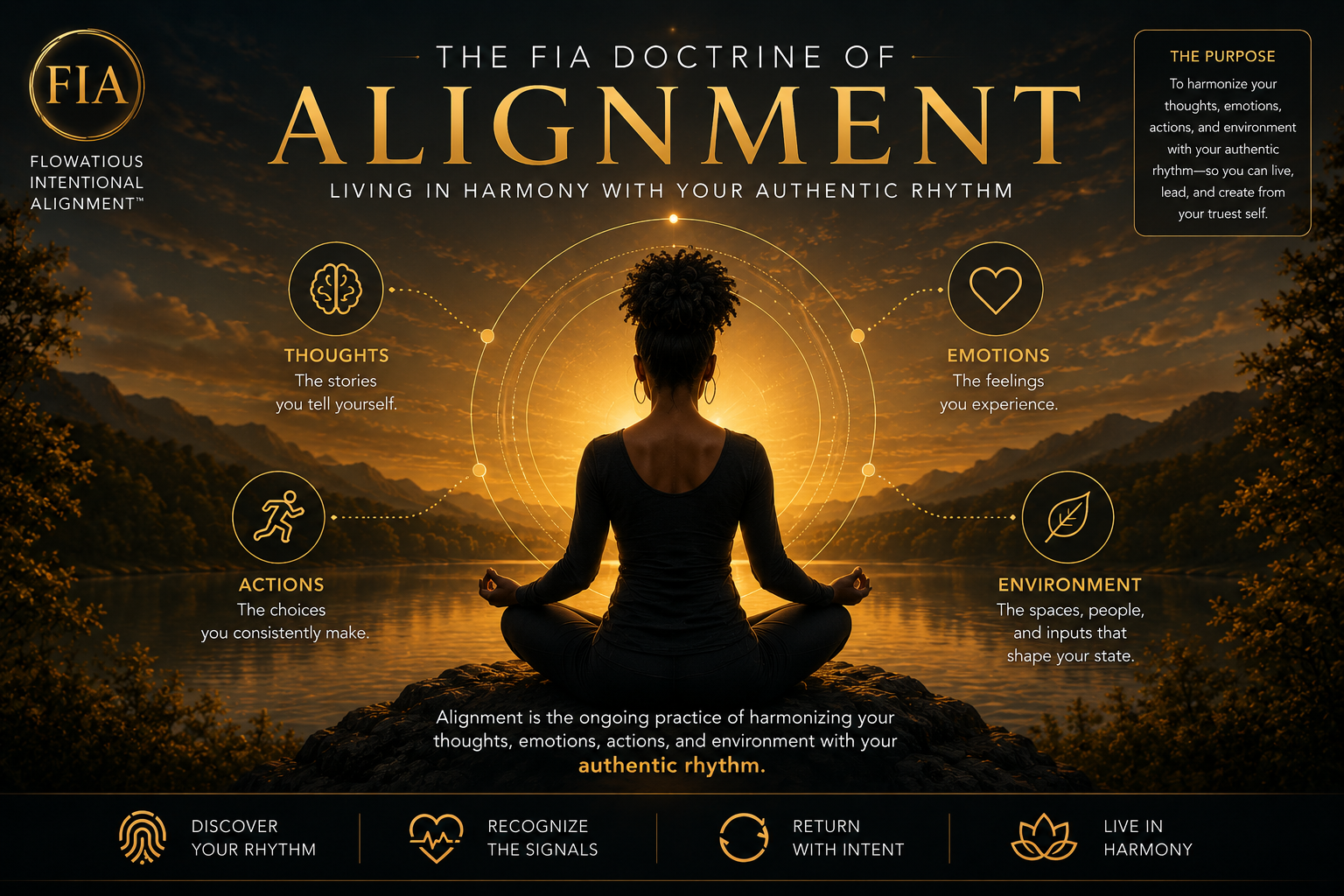
The FIA Definition of Alignment
Alignment is not perfection. Alignment is not constant happiness. Alignment is not the absence of challenge.
Alignment is not becoming someone else.
Within Flowatious Intentional Alignment (FIA), alignment is defined as:
Alignment is the ongoing practice of harmonizing one's thoughts, emotions, actions, and environment with one's authentic rhythm.
Alignment is not a destination to arrive at. It is a lifelong practice of returning to yourself.
The Four Domains of Alignment
FIA teaches that alignment occurs across four interconnected domains.
Thoughts
The stories, beliefs, and perspectives that shape your experience.
Reflection: Are your thoughts supporting your authentic rhythm or reinforcing borrowed rhythms?
Emotions
The feelings and internal signals that communicate your current state.
Reflection: Are you responding to your emotions intentionally or reacting automatically?
Actions
The behaviors and habits you practice daily.
Reflection: Do your actions reflect who you truly are?
Environment
The people, spaces, conversations, and influences that shape your rhythm.
Reflection: Does your environment support your highest expression?
Alignment Is Not Perfection
One of the greatest misconceptions about alignment is the belief that aligned individuals never struggle. FIA teaches something different.
Aligned individuals still experience:
Stress
Fear
Uncertainty
Grief
Frustration
Dysregulation
The difference is not the absence of challenge. The difference is the ability to recognize what is happening and intentionally return to alignment.
Misalignment Is Information
Most people view misalignment as failure. FIA views misalignment as feedback. Misalignment is often your Frequency Body communicating that something within your thoughts, emotions, actions, or environment is no longer harmonizing with your authentic rhythm.
Instead of asking: "What is wrong with me?"
FIA encourages a different question: "What is this experience attempting to show me?"
Misalignment is not the enemy. It is often the beginning of awareness.
Alignment vs Misalignment
Alignment
Thoughts support your authentic rhythm
Emotions are acknowledged and regulated
Actions reflect your values
Environment supports your growth
Result:
Clarity, coherence, and intentional movement
Misalignment
Thoughts contradict your deeper knowing
Emotions are ignored or overwhelming
Actions are driven by conditioning
Environment reinforces borrowed rhythms
Result:
Friction, confusion, and internal conflict
What Alignment Is Not
Alignment is not:
Constant happiness
Positive thinking at all times
Perfection
Avoiding difficult emotions
Spiritual performance
Alignment is:
Awareness
Honesty
Regulation
Realignment
Returning to your authentic rhythm
The Art of Returning
Perhaps the most important FIA teaching is this: Alignment is not about never drifting. Alignment is about learning how to return.
Life will always present distractions, challenges, transitions, and uncertainty. Drifting is inevitable. Returning is intentional. The FIA journey is not measured by how rarely you drift. It is measured by how skillfully you return to your authentic rhythm.
Why Alignment Looks Different for Everyone
No two authentic rhythms are identical. As a result, alignment will not look the same for everyone. One person may find alignment through leadership. Another may find alignment through reflection. One may thrive through community.
Another may thrive through solitude. The goal of FIA is not conformity. The goal of FIA is congruence. Alignment occurs when your outer expression increasingly reflects your authentic rhythm.
Begin Your Alignment Journey
Alignment begins with awareness.
Explore the foundations of FIA and discover how to recognize your authentic rhythm, understand your Frequency Body, and cultivate greater harmony within your life.