
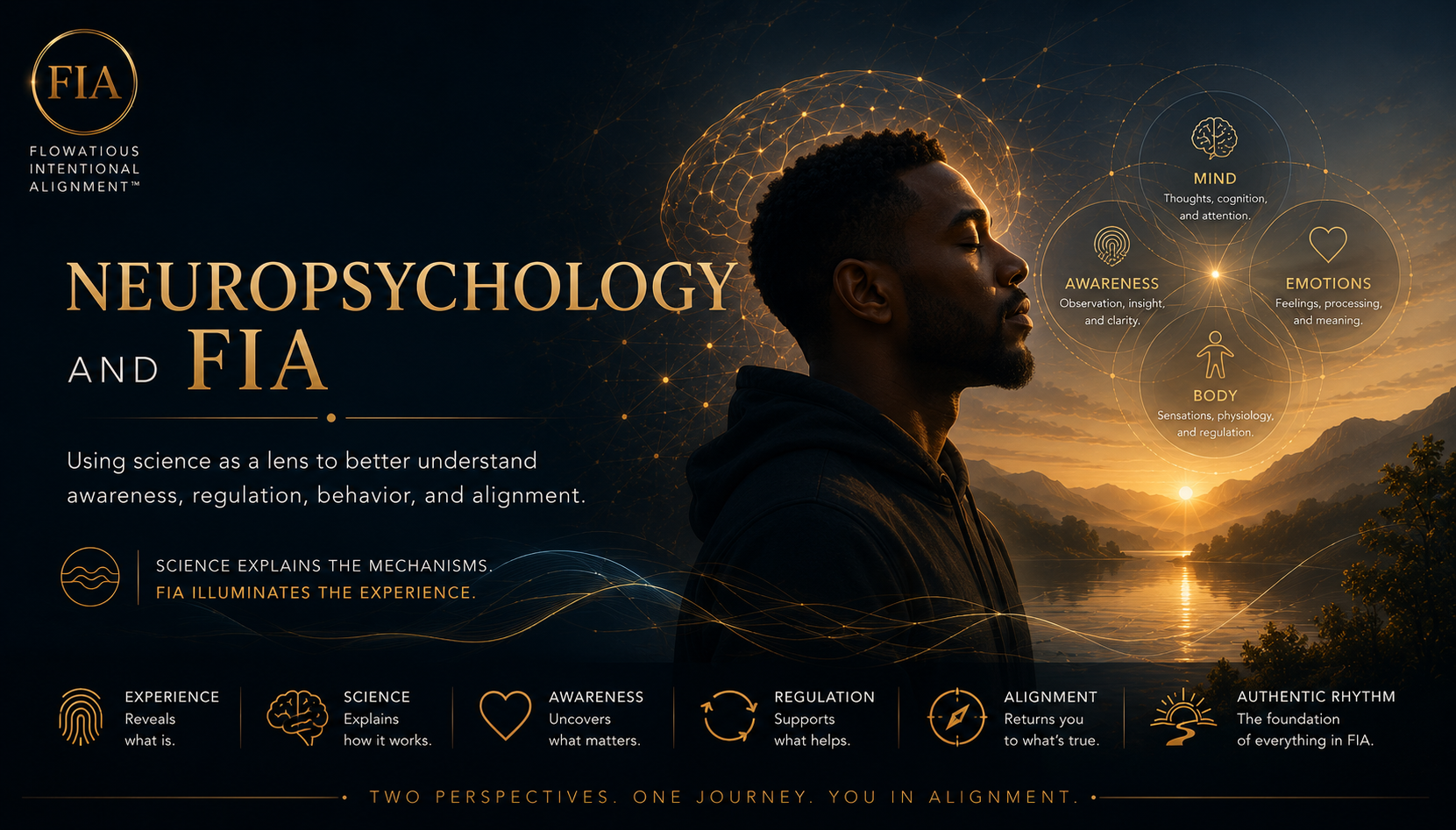
Neuropsychology and FIA
Using science as a lens to better understand awareness, regulation, behavior, and alignment.
Why This Page Exists
As the FIA framework evolved, many of its teachings began touching areas that are also explored within modern neuroscience, psychology, and neuropsychology.
Concepts such as regulation, stress responses, awareness, attention, emotional processing, behavior patterns, and internal sensing.
all have scientific counterparts. This page exists to clarify the relationship between FIA and Neuropsychology.
What Is Neuropsychology?
Neuropsychology is the study of how the brain, nervous system, and cognitive processes influence thoughts, emotions, behaviors, perception, and daily functioning.
It explores questions such as:
How does stress affect behavior?
How does attention work?
How are emotions processed?
How do habits develop?
How does the nervous system influence experience?
Neuropsychology seeks to understand the relationship between the brain and human behavior.
The FIA Perspective
FIA is not a neuropsychology framework.
FIA is a framework for intentional alignment.
Its purpose is to help individuals reconnect with their Authentic Rhythm through awareness, regulation, reflection, and intentional action.
However, neuropsychology often provides useful explanations for experiences that FIA observes.
Science and Experience
One of the central teachings within FIA is that lived experience matters.
A person may experience:
Anxiety
Overwhelm
Disconnection
Calm
Clarity
Expansion
before they ever understand the science behind those experiences. Science helps explain. Experience helps reveal. Within FIA, both are valuable.
Where Neuropsychology Supports FIA
1. Regulation
The FIA Regulation System is built upon the understanding that our internal state influences how we think, feel, and behave.
Neuropsychology helps explain:
Stress responses
Nervous system activation
Cognitive flexibility
Emotional regulation
Attention and focus
This supports FIA's teaching that regulation often influences access to clarity and alignment.
2. The Frequency Body
The Frequency Body is FIA's term for the dynamic system through which thoughts, emotions, sensations, physiology, and environmental influences interact.
While the Frequency Body is an FIA concept, neuropsychology helps explain many of the biological processes that contribute to these experiences.
Examples include:
Nervous system activity
Brain-body communication
Emotional processing
Stress physiology
Perception
3. Visceral Awareness
FIA teaches that internal sensations often carry valuable information.
Neuropsychology supports this understanding through research involving:
Interoception
Emotional awareness
Body-based processing
Internal signal detection
This helps explain why paying attention to bodily signals can influence awareness and decision-making.
4. Patterns and Behavior
FIA encourages individuals to observe recurring patterns.
Neuropsychology explores:
Habit formation
Behavioral conditioning
Attention biases
Emotional learning
Cognitive patterns
Together, these perspectives help illuminate how people become trapped within repeated cycles—and how change becomes possible.
Neuropsychology Is A Lens, Not The Foundation
One of the most important distinctions within FIA is this:
Authentic Rhythm remains the foundation.
Neuropsychology remains a lens. The FIA Ecosystem is organized around Authentic Rhythm. Science helps explain some of the pathways that influence a person's ability to access and live from that rhythm. The science supports the framework.
The science does not define the framework.
The Relationship Between Science and FIA
A simple way to understand the relationship is:
FIA Describes The Experience

Neuropsychology Helps Explain The Experience
or
FIA = The Practice

Neuropsychology = The Explanation
Both perspectives can coexist.
Why This Matters
Many people find themselves caught between two extremes. One side values only science. The other side values only subjective experience. FIA takes a different approach.
The framework recognizes that: Experience matters. Awareness matters. Science matters. And regulation matters.
Each can contribute to a deeper understanding of ourselves.
The FIA Ecosystem Connection
Within the FIA Ecosystem:
Authentic Rhythm
        ↓
Neuropsychology
        ↓
Interoception
        ↓
Visceral Awareness
        ↓
The Frequency Body
        ↓
The FIA Regulation System
        ↓
Alignment
Neuropsychology helps bridge scientific understanding and lived experience.
Reflection:
What experiences in my life have I felt before I understood them?
How has greater awareness changed my relationship with myself?
Where might science and lived experience complement one another in my own growth?
Neuropsychology helps explain the mechanisms.
FIA helps illuminate the experience.
Together, they offer two perspectives on the same journey:
The ongoing process of understanding ourselves, regulating our internal state, and living in greater alignment with our Authentic Rhythm.